The involvement of children in armed conflicts has reached unprecedented levels, with a record of 38 558 serious violations confirmed in 2025. As modern warfare shifts to urban areas and humanitarian aid is systematically blocked, children face escalating risk of death, injury and exploitation. Recent UN data reveals that for the first time, state actors and government forces are responsible for more violations against children than non-state armed groups. Despite global initiatives and programs actively rescuing thousands of minors, the escalating crisis demands urgent international accountability.
Understanding the Issue
The involvement of children in armed conflicts represents a systemic violation of human rights and humanitarian law. As conflicts force communities to flee, the traditional systems meant to protect children collapse entirely. Separated from their families and travelling through dangerous transit points, unaccompanied children become exceptionally vulnerable to trafficking networks and armed groups.
Armed groups often use oppressive tactics, deception, or a false promise of security to recruit vulnerable minors. Once they are part of these groups, children are compelled to perform a variety of operational functions such as combat roles, vital support capacities, cooks, cleaners, spies, or porters [1].
These functions are highly gendered. For example, girls are frequently distributed among adult fighters to serve as “bush wives” [2], sexual slaves and caregivers. Boys are mostly performing as scouts, informants in hazardous areas, or are deployed to the front lines and forced to engage in active fighting.
Historically, non-state armed groups and terrorist organizations were the primary perpetrators of these severe violations. Factions such as the Lord’s Resistance Army, Boko Haram and the Islamic State have relied heavily on abducted children to expand their ranks and sustain their operations. However, the recent UN annual report reveals that for the first time in the 30-year history of the UN's monitoring mandate, government forces and state actors were responsible for more grave violations against children than non-state armed groups.
According to the data presented in the report, state forces were responsible for 15 881 verified violations, exceeding the 15 616 violations committed by non-state actors. The report specifically identifies these government and state actors as the main perpetrators behind the killing and disabling of children, attacks on schools or hospitals, and the denial of humanitarian access [3].
The Current State
In 2025, the UN confirmed a total of 38 558 serious violations against children in war zones. These acts directly affected 24 174 children with approximately one-third of all victims being girls. This number also represents the highest number of affected children recorded since the monitoring mandate was established [4]. The data shows that the risks are adding up, as a large number of victims suffer from several abuses at the same time.
The changing methods of modern warfare are directly linked to a 34% increase in child deaths and a 10% increase in injuries. This escalation is largely due to hostilities shifting from traditional battlefields into populated urban areas where the use of explosive weapons causes widespread devastation. In addition, the rising use of drones and AI in targeting makes it easier for military leaders to feel disconnected from the human cost of war.
As a result, safe spaces like schools and hospitals are regularly attacked, damaged or occupied for military operations. At the same time, combatants are systematically disrupting relief efforts by blocking aid convoys, creating severe bureaucratic hurdles and targeting humanitarian workers. Denying lifesaving assistance has increasingly become a weapon of war, documented in 8 322 verified incidents of blocked access in 2025.
The highest concentration of serious violations against children occurs in the Occupied Palestinian Territory, Israel, the Democratic Republic of Congo, Nigeria, Myanmar and Somalia. In Gaza and Myanmar, warring parties use explosive weapons in populated urban areas. In the Democratic Republic of Congo, Nigeria or Somalia, armed fractions, such as Boko Haram, exploit weakened or collapsed state structures to realize mass abductions, forced recruitment or sexual violence against minors.
Global Response
To protect children and enforce accountability, entities like the UN Children’s Fund and the Office of the Special Representative actively coordinate global advocacy and protection strategies. This work is reinforced by judicial bodies like the International Criminal Court, which plays a critical role by prosecuting the recruitment and use of child soldiers as a war crime. Recently, they have sent a strong warning through the conviction of Thomas Lubanga Dyilo for recruiting child soldiers.
Over time, these initiatives have secured the release of more than 220 000 children from armed forces and groups. In 2025 alone, more than 13 000 former child soldiers received critical protection and reintegration services. Crucial to these recovery efforts are DDR programs [5] which serve as essential frameworks for transitioning children back into civilian life. That is made by providing psychical care, psychological support, education and vocational training.
Beyond the efforts of individual organizations, there are specific frameworks to guide global action and peacekeeping. Key agreements like the Paris Principles provide essential guidelines to prevent recruitment and ensure that children are treated as victims rather than criminals during their recovery. Building on this, the Vancouver Principles aim to make child protection a top priority in UN peacekeeping operations, making sure that troops are specifically trained to recognize and stop the use of child soldiers.
The UN Security Council also plays a crucial role by maintaining a strict monitoring and reporting mechanism. By publicly listing armed groups and state forces that commit these violations, the UN pressures these actors into signing formal action plans to release children and to cease abuses. This mechanism drives ongoing accountability efforts, as the Office of the Special Representative of the Secretary-General for Children and Armed Conflict is currently negotiating new protective agreements with Myanmar, Sudan and the Syrian Arab Republic.
The facts are undeniable, and they point to a reality we can no longer ignore. Perhaps the best conclusion was already made by Vanessa Frazier, the UN Special Representative for Children and Armed Conflict, during the UN Security Council Open Debate in June 2026: "Children are not collateral damage. They are not bargaining chips. They are not a by-product of strategy. They are not expendable. And yet, conflict after conflict, children are treated as if their lives can be sacrificed in pursuit of military advantage, territorial control, political dominance, financial gain, or outright destruction,."
Remarks
[1] In conflict zones, a “porter” refers to an individual forced or hired to carry heavy loads, supplies and equipment for armed forces or rebel groups.
[2] "Bush wives" is a term that refers to women/girls who are abducted into serving as forced wives and domestic/sexual servants to combatants during armed conflicts.
[3] Safe, unhindered and timely entry of aid organizations and relief supplies to populations in need, as well as the freedom of affected people to reach life-saving assistance.
[4] The Monitoring and Reporting Mechanism was established by the UN Security Council in July 2005 via Resolution 1612.
[5] Disarmament, demobilization and reintegration programs.
Sources
Canada International. (2026). Vancouver Principles on Children and Armed Conflict. Dostupné z: https://www.international.gc.ca/world-monde/issues_development-enjeux_developpement/human_rights-droits_homme/principles-vancouver-principes-pledge-engageons.aspx?lang=eng
ETH Zürich. (2026). ISN Publication Research Report 712. Dostupné z: https://www.files.ethz.ch/isn/27910/712.pdf
HRW. (2026). International Justice: Joseph Kony - LRA. Dostupné z: https://www.hrw.org/topic/international-justice/joseph-kony-lra
ICC. (2026). The Democratic Republic of the Congo: The Case of Thomas Lubanga Dyilo. Dostupné z: https://www.icc-cpi.int/drc/lubanga
ICC. (2026). The International Criminal Court Portal. Dostupné z: https://www.icc-cpi.int/
OSRSG CAAC. (2021). Children and Armed Conflict: Report Summary 2020. Dostupné z: https://childrenandarmedconflict.un.org/sites/default/files/2021/06/Chi…
OSRSG CAAC. (2024). Child Trafficking and Armed Conflict. Dostupné z: https://childrenandarmedconflict.un.org/sites/default/files/2024/10/Child-trafficking-and-armed-conflict-2.pdf
OSRSG CAAC. (2025). Summary of the Annual Report on Children and Armed Conflict. Dostupné z: https://childrenandarmedconflict.un.org/sites/default/files/2025/06/Summary-of-the-Annual-Report-on-Children-and-Armed-Conflict.pdf
OSRSG CAAC. (2026). A Year of Unthinkable Suffering: Record Number of Children in Conflict Victims of Grave Violations in 2025. Dostupné z: https://childrenandarmedconflict.un.org/en/news/year-unthinkable-suffering-record-number-children-conflict-victims-grave-violations-2025
OSRSG CAAC. (2026). Security Council Open Debate on Children and Armed Conflict: Remarks by USG CAAC Frazier. Dostupné z: https://childrenandarmedconflict.un.org/en/news/security-council-open-debate-children-and-armed-conflict-remarks-usg-caac-frazier
OSRSG CAAC. (2026). Child Soldiers: One of the Six Grave Violations. Dostupné z: https://childrenandarmedconflict.un.org/en/six-grave-violations/child-soldiers
OSRSG CAAC. (2026). The Mandate of the Special Representative of the Secretary-General for Children and Armed Conflict. Dostupné z: https://childrenandarmedconflict.un.org/en/about/the-mandate/special-representative/special-representative-of-the-secretary-general-for-children-and-armed-conflict
Pearson, E. & Zenn, J. (2021, February). Boko Haram, the Islamic State, and the Surge in Female Abductions in Southeastern Niger. ICCT Research Paper. Dostupné z: https://icct.nl/sites/default/files/2022-12/Pearson-And-Zenn-research-paper.pdf
ReliefWeb. (2026). Children and armed conflict: Report of the Secretary-General (A/80723-S2026357). Dostupné z: https://reliefweb.int/report/world/children-and-armed-conflict-report-secretary-general-a80723-s2026357
UN News. (2026). 'Darkest chapter': Record child violations in 2025, with national forces leading the way. UN News. Dostupné z: https://news.un.org/en/story/2026/06/1167747
UN News. (2026). Security Council LIVE: Open debate on children and armed conflict. UN News. Dostupné z: https://news.un.org/en/story/2026/06/1167795
UN Security Council Report. (2026). Children and Armed Conflict Annual Open Debate. What's Blue. Dostupné z: https://www.securitycouncilreport.org/whatsinblue/2026/06/children-and-armed-conflict-annual-open-debate-5.php
UN Security Council. (2026). United Nations Security Council Portal. Dostupné z: https://main.un.org/securitycouncil/en
UN. (2026). Conflict-related sexual violence: Report of the Secretary-General (S/2026/321). Dostupné z: https://www.un.org/unispal/document/conflict-related-sexual-violence-report-of-the-secretary-general-s-2026-321/
UNIDIR. (2023). Children and Conflict Research Paper (315). Dostupné z:https://unidir.org/wp-content/uploads/2023/09/children-and-conflict-en-315.pdf
UNICEF. (2026). Paris Principles: The Mali Media Resource Document. Dostupné z: https://www.unicef.org/mali/media/1561/file/parisprinciples.pdf
UNICEF. (2026). Take Action Campaigns: Children Under Attack. Dostupné z: https://www.unicef.org/take-action/campaigns/children-under-attack
UNICEF. (2026). UNICEF's Action against Child Trafficking. Dostupné z: https://www.unicef.org/media/172716/file/UNICEF%E2%80%99s%20Action%20against%20Child%20Trafficking.pdf
USCIRF. (2026). Did you know: Boko Haram Nigeria. Dostupné z: https://www.uscirf.gov/publications/did-you-knowboko-haram-nigeria
War Childhood. (2026). Children and Armed Conflict Legal Framework. Dostupné z: https://warchildhood.org/children-and-armed-conflict-legal-framework/
Wilson Center. (2026, July). Timeline: The Rise, Spread, and Fall of the Islamic State. Dostupné z: https://www.wilsoncenter.org/article/timeline-the-rise-spread-and-fall-the-islamic-state
Photo
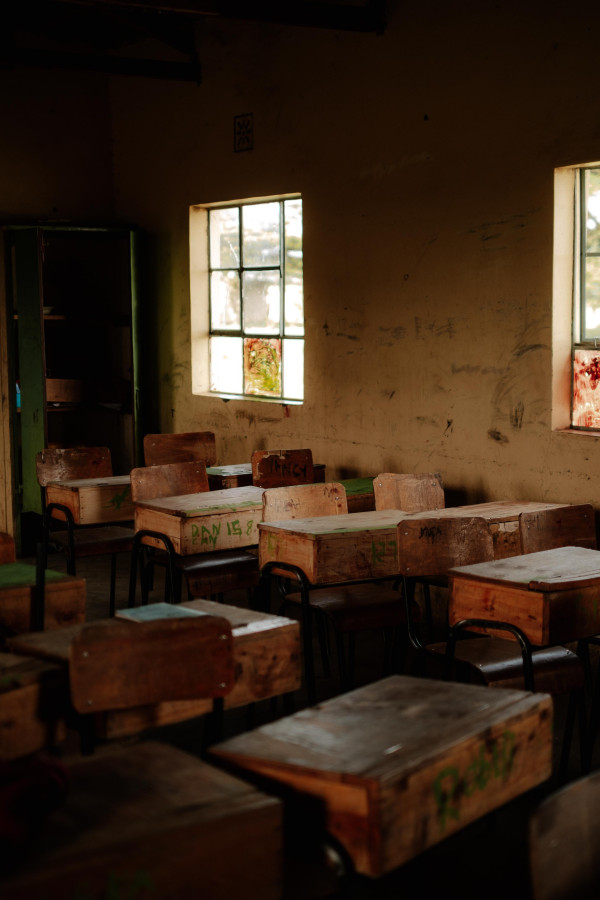
Škola v Keni, autor: Julie Šustík, 2025.